
The acronym SMARTER is used in the fitness industry as a tool to ensure programs meet certain criteria. Here we will go through each one and explain it a little bit more.
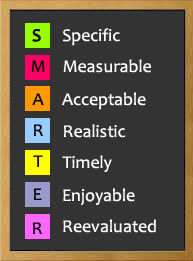
S – Specific
Many clients have told me they want to tone up and lose weight. As a trainer I need to get more detail to help them achieve their goals. Therefore a more specific answer would be to increase overall muscle definition and to lose 14 lbs of body fat. Now that we have specific goals, we can measure….
M – Measurable
In order to know if the program is helping a client achieve their desired results we need to measure weight, body fat percentage and maybe even anatomical measurements at the beginning, middle and end of the program. If results aren’t being hit, at least it’s known and changes can be made if necessary.
A – Acceptable
The word attainable may also be used here and this point almost piggy backs on the next but there can be subtle differences. An overweight client with a history of knee pain wanting to train for a marathon in 6 months may be attainable but may not be realistic given the chance of re-injury.
R – Realistic
Some clients believe losing 3 stone in a month is possible or that training for a marathon can be done in 3 months with no previous history of road running. Clients, sometimes, need to be told that goals are not realistic and re-evaluate their thought process.
T – Timely
Again slightly piggy backing on the above points. A client wanting to train for a marathon in a timeframe of 6 months is timely but not if the timeframe is 2 months with no previous training. This wouldn’t be timely, acceptable or realistic.
E – Enjoyable
If exercise isn’t enjoyable the chances of not continuing are slim. Running groups, exercise classes or simply using a facility where you feel comfortable chatting with other members can go a long way to getting you off the couch and into the gym without giving it a second thought.
R – Re-Evaluate
If a client wants to lose body fat, then perform a body fat test. If a client wants to get stronger, perform 1-2 strength tests. The only way to know you are making progress is to test it periodically. Don’t depend on how you look to determine of you are getting results from a given program. When you see something every day you don’t notice changes over a long period of time. Before and after pictures taken 10-12 weeks apart can be used to see aesthetic differences along with fitness testing because lets face it, who doesn’t want to look better for the effort of doing an exercise program!
So there you have it, time to ask yourself and you training SMARTER?
Photo credits:
http://www.vancouverbankruptcyservice.org/vancouver-credit-counselling/smarter-financial-goals/
 markcaulfieldcoaching.ie
Leave a comment