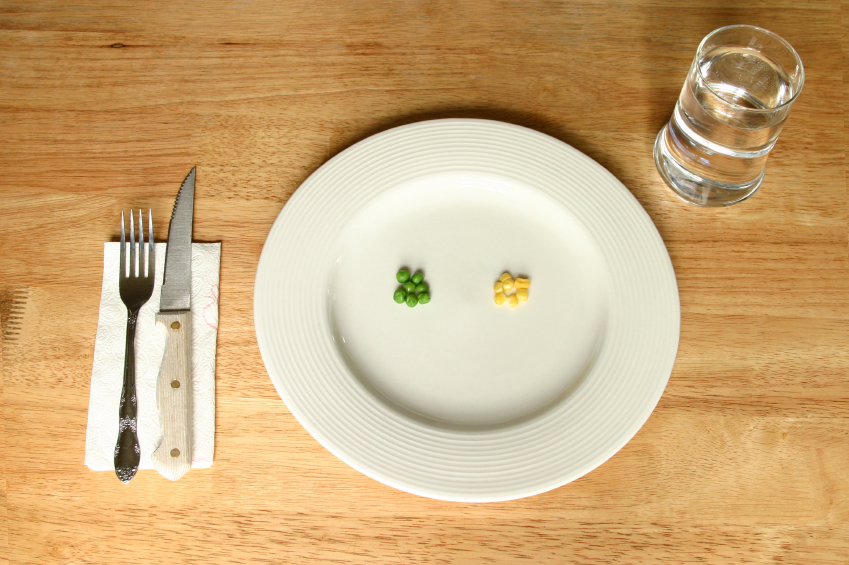
“Where there’s a will, there’s a way”
Ever try to drive a nail into a wall with a sponge?
Sometimes “will” alone won’t cut it. You need the right tools for the job.
If you are reading this you are (probably) either thinking about trying to lose fat, currently trying (through diet or exercise or both) to lose fat, or you have tried before and failed and will soon become one of the 2 previous people I mentioned again soon. It’s a vicious circle and I’m here to tell you that (a) you’re not alone and (b) it’s not because you aren’t trying hard enough!
YOUR BODY IS ACTIVELY WORKING AGAINST YOU.
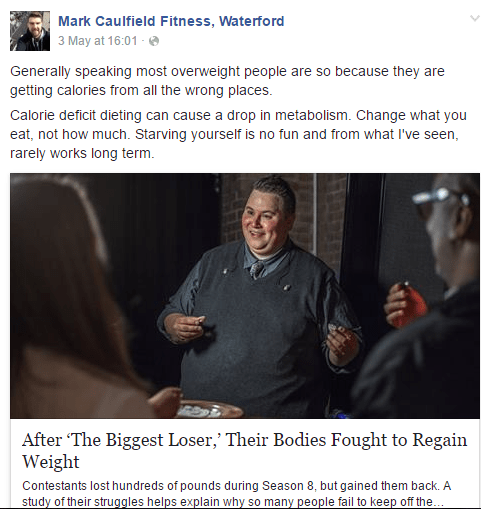
An article on my Facebook page wrote of the re-gain in weight of The Biggest Loser contestants. They were on MASSIVE calorie deficit diets and burned even more calories through exercise. The long term result – massive weight gain.
INTRODUCTION
I read an intriguing article recently entitled “Why You Shouldn’t Exercise To Lose Weight” and one of the areas I would like to focus on is calorie deficit diets i.e. reducing daily caloric intake in an effort to drop weight/fat.
I believe it’s fair to say that many of us (even me!) were told that if you can decrease calorie intake by 500 calories or increase calorie expenditure by 500 per day for a week that you would create a deficit of 3500 calories which equates to 1lb of fat. The logic for this is because 1lb of fat contains 3500 calories.
In theory it’s hard to disagree with that isn’t it?
BUT IT’S A LIE! Or at least, misinformed.
I’m going to tell you why. If you have been trying to lose fat on a hugely reduced calorie diet you need to read on because you are fighting a battle you knew nothing about AND IT’S NOT YOUR FAULT! Well, kind of, it’s your metabolisms fault.
WHAT IS METABOLISM?

Your basal metabolic rate (metabolism) is the amount of energy your body needs to survive while at rest. This is the bottom line for calories for you to function. Generally, your metabolism accounts for 65% or more of daily caloric burn with muscle mass accounting for 50% according to THIS article.
Metabolism is NOT a constant figure however with the amount of calories needed by each person depending on gender, muscle mass, hormone levels and activity levels. It’s not as simple as 2000 calories per day for women and 2500 calories per day for men and compensating more or less calories for physical activity or lack therof.
METABOLIC COMPENSATION
When you restrict calorie intake by a large amount your metabolism must adjust its energy consumption. It needs to become more economical as it’s running on less energy. Low-cal diets can cause a slow down in the rate at which your metabolism burns calories. This compensation can range anywhere from 200-800 calories per day and can lead to, not only a plateau in your weight loss, but a gain in weight!
Here’s a simple example:
Your TDEE (Total Daily Energy Expenditure) ) is 2000 calories. You have been taking in 2500 calories. You drop to 1800 calories, a total reduction of 700.
The reduction in calories shows an initial weight loss so you continue your low-cal diet but you are hungry, a lot!
Your metabolism compensates for this and reduces energy consumption. This is called metabolic compensation.
These metabolic compensations can last for day(s), weeks, even years depending on the severity of the diet. Your body will fight against the weight loss because it sees it as a threat. Commonly known as starvation mode, your body wants to maintain energy balance so your metabolic rate drops to conserve energy and, guess what?
IT INCREASES CRAVINGS FOR FOOD TOO!!
All that guilt you had for eating that bar of chocolate and it was your body fighting against you, not a lack of will power!
Add in an extra couple of training sessions and guess what your body will do? Fight back even harder! It will make you lazier too, to conserve even more energy. Ever wonder why you go to bed so much earlier when you start working out? Ever wonder why you were so hungry after that run or circuit class? Your body is actively trying to prevent you from losing weight!!!!!
SUMMARY
You drop the calories consumed. You lose weight. Your metabolism compensates to prevent the loss. It increases cravings and hunger. It makes you lazier to conserve energy. You gain weight or stop losing weight. You either quit because it’s not working or you reduce calories/increase exercise further, exaggerating the compensation. You gain weight.
The burning question:
If I can’t lose extra weight/fat by cutting calories or increasing exercise, how can I lose it?
The answer will be revealed in my next blog post. Subscribe by entering your email at the bottom of the page HERE to see it first!
Referenced articles:
https://authoritynutrition.com/starvation-mode/
http://ajcn.nutrition.org/content/88/4/906.long
http://www.vox.com/2016/4/28/11518804/weight-loss-exercise-myth-burn-calories
 markcaulfieldcoaching.ie
This is such an insightful article! I am incredibly grateful to be living in a time when we have access to the wealth of information that allow us to train, think and move in a way that is sustainable and leads to real results.
LikeLike